


- Shop
- About us
- DSLocate App
- Your industry
- FAQ
- Blog
- Contact
-
Monitoring for
 sales representatives
 service technicians
 delivery drivers
 vehicle rental companies
 distributors
 construction machinery
 forklifts
 waste containers
 agricultural machinery
 trailers
 refrigerated vehicles
 municipal vehicles
 trucks
 buses
buses boats
boats people and objects
 theft protection
 mobile objects
App vs. OBU or ZSL devices - which to choose for e-TOLL? Pros and cons
11.12.2025
Managing transport is a constant battle for profitability, and the e-TOLL toll collection system has become an indispensable part of that puzzle. When you are faced with choosing a payment method for the paid sections of national roads, at first glance it seems straightforward. You have a choice between the free government application and paid external devices.
Economic logic suggests cutting costs wherever possible. However, with e-TOLL, the ‘free’ solution can generate costs that far outweigh the price of professional hardware. A fine for a single unpaid trip can be as much as 1,500 zł. Is it worth risking your company’s financial security for an apparent saving? Let us look at what genuinely differentiates the application from professional GPS trackers.
The e-TOLL PL app – free, but is it actually cheap?
The government e-TOLL app is available to anyone with a smartphone. That is its biggest – and essentially its only – advantage over dedicated hardware. You download it, set up an account, top up your balance, and head out on the road. The absence of any initial cost means many business owners, particularly smaller ones, opt for this route.
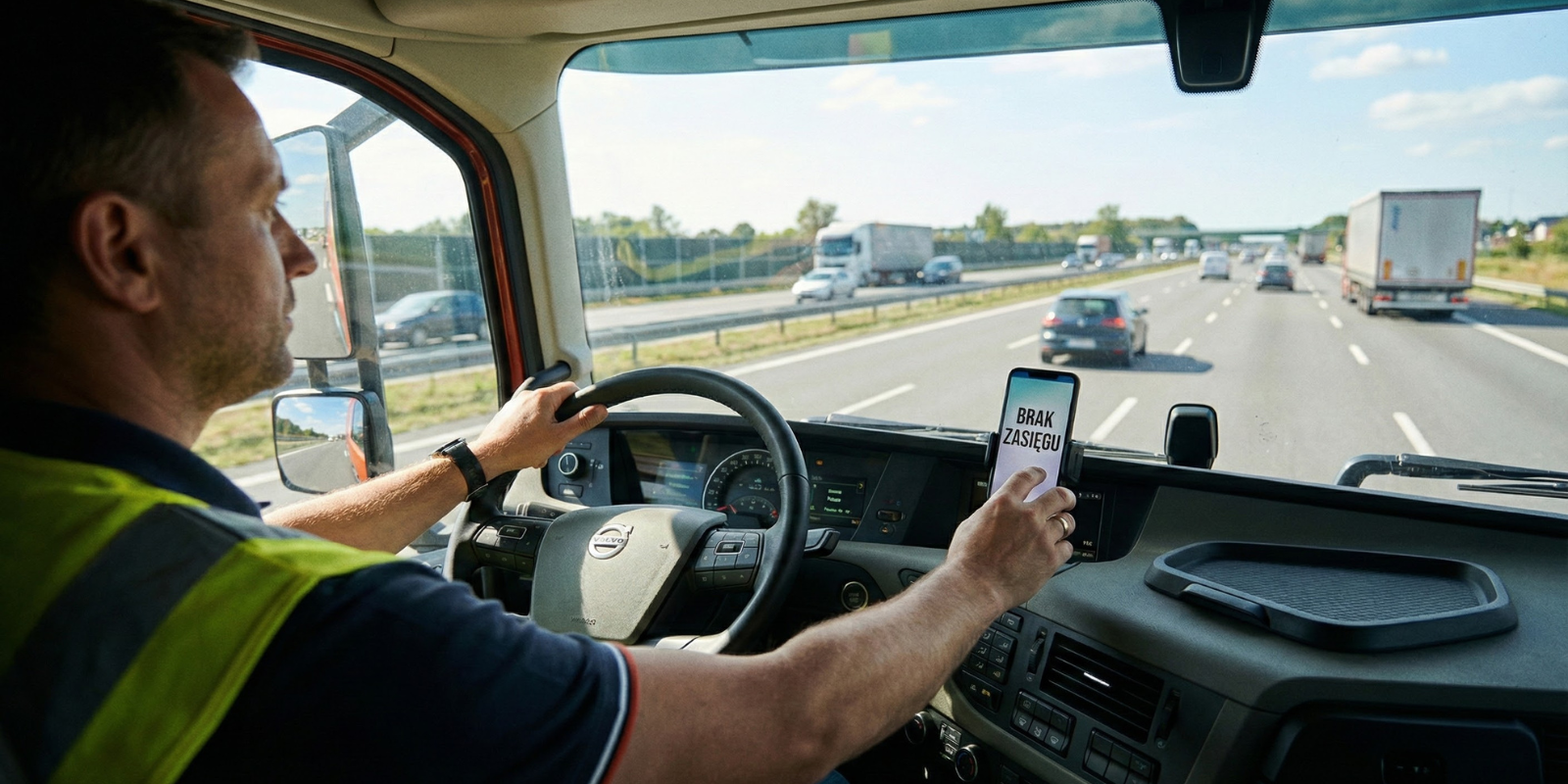
The problem begins when you realise that a smartphone is a multi-purpose device, not a professional GPS tracker. A phone is used by the driver for calls, navigation, listening to music, and handling dispatch instructions. The e-TOLL app has to run in the background, and mobile operating systems (Android and iOS) have a tendency to ‘kill’ background processes that consume battery power in order to save energy.
Here is what you are risking if you rely solely on the phone app:
-
Data transmission interruption: All it takes is the driver entering a weak signal area or losing the internet connection, and the system stops recording the charge.
-
Human error: The driver must remember to start the app before entering a paid section and stop it after exiting. Amid a busy workload, this is easily forgotten.
-
Hardware issues: A flat battery, a phone overheating on the dashboard shelf on a hot day, or the system freezing during an incoming call – these are all scenarios that end in an administrative penalty.
By using the app, you place the entire responsibility on the driver. Instead of concentrating on the road, they have to keep checking whether the app is definitely ‘showing green’.
OBU and ZSL devices – technology that takes the problem off your hands
The alternative to the unreliable app is dedicated devices that are physically present in the vehicle. There is no room for chance here. This is hardware designed for a single purpose: to accurately record charges and transmit geolocation data.
When looking at a ZSL or OBU tracker, it is worth understanding the difference in how they are fitted, as the operating principle is similar:
-
OBU (On-Board Unit): A small box that you plug into the cigarette lighter socket or OBD port. It is mobile – you can easily move it from one vehicle to another, which is ideal for fleets with rotating vehicles.
-
ZSL (External Location System): A device fitted permanently, hidden deep behind the dashboard and wired into the vehicle’s electrical installation. The driver has no access to it and cannot accidentally disconnect or misplace it.
By choosing solutions such as Data System e-TOLL, you gain reliability. These devices have their own GPS modules and SIM cards that operate independently of the driver’s phone. Moreover, professional GPS trackers often have built-in buffer memory. If the vehicle enters a tunnel or loses GSM signal, the device stores the route and transmits the data immediately upon regaining a connection, protecting you from fines.
App versus hardware – where do the real operational differences lie?
When considering the differences between the e-TOLL app and OBU, the key word is ‘automation’. With the app, the process is manual and prone to errors. With an OBU or ZSL, it happens without the driver being aware of it.
Imagine this scenario: a driver enters a paid section of the A4 motorway. The dispatcher rings, and navigation is running in the background. The phone is under load. The e-TOLL app, running in the background, may be suspended by the phone’s operating system or lose the GPS signal. The driver will not even notice. An ITD inspection will detect the missing payment, and you will receive a demand for payment. e-TOLL penalties are applied without mercy – it is a binary system.
With an OBU or ZSL device, the driver turns the key in the ignition and the device starts automatically. Indicator lights confirm it is functioning correctly. Even if the driver is on the phone or their smartphone dies, toll recording continues uninterrupted. This is precisely why the peace of mind and the absence of any need to constantly monitor the app’s status are the greatest added value of paid solutions.
When is it worth sticking with a phone, and when is investing in an OBU essential?
To be honest – the app is not inherently bad. If you run a construction company and once a quarter you need to transport an excavator on a low-loader along a motorway, or you are driving your campervan on holiday – the app is perfectly adequate. For occasional trips, the risk is acceptable and the saving on buying a device is justified.
The situation changes dramatically when transport is part of your daily business. If your vehicles are on the road regularly, the pros and cons of e-TOLL settlement tip decisively in favour of physical devices.
Why does OBU/ZSL win in professional transport?
-
No risk of fines: The cost of the device pays for itself sooner than you might think – avoiding just one penalty is enough to cover the investment.
-
Fleet control: Devices from Data System are often not just e-TOLL but full GPS monitoring. You can see where your vehicles are, how much fuel they are using, and how your drivers are driving.
-
Convenient billing: All data flows into a single system, which simplifies accounting and cost management.
Summary
Choosing between an app and an OBU/ZSL device is in reality a choice between an apparent saving and peace of mind and business security. In professional transport, where reliability is everything, relying on a driver’s smartphone is a risky game. One phone failure or a moment of inattention can cost you 1,500 zł.
If you value predictable costs and want to take the burden of managing the toll payment system off your drivers, professional devices are the only logical choice.
FAQ – frequently asked questions
1. What happens if the e-TOLL app stops working while driving? If the app stops transmitting geolocation data to the system (e.g. due to loss of signal, phone failure, or the app being closed), the charge will not be recorded. In the event of an inspection (including automated checks by cameras on overhead gantries), you face an administrative penalty. The driver is required to stop at the nearest safe location and pay the toll by an alternative method, or wait for the system to resume functioning.
2. Can I use an OBU device in several vehicles? Yes, this is one of the main advantages of OBU. The device is linked to a specific account, but it can be moved between vehicles. However, you must remember to update the information in the e-TOLL system (Online Customer Account) to show which vehicle the device is currently in, so that the correct tariff is applied for that vehicle category.
3. Does ZSL require complex installation and a workshop visit? A ZSL (External Location System) requires permanent connection to the vehicle’s electrical system. It is recommended that installation is carried out by a qualified fitter, which guarantees correct operation and no interference with other vehicle systems. In the case of Data System, this process is quick and can be performed by a mobile service engineer at the customer’s premises.
Check out the Data System range and choose the solution that protects your business from unnecessary expenditure. Get in touch with us – we will be happy to recommend the best billing model for your business.